News Center Articles JBC Interview – A Deep Dive into B.IRON Battery-Powered Soldering System
In this exclusive interview, we sat down with one of our experienced JBC technicians to explore the story behind JBC’s B.IRON — the company’s first battery-powered soldering station. Compact, cordless and built for precision, B.IRON represented a bold step toward portability without compromising performance.
#1: Even as electronics manufacturing shifts toward tiny surface-mount components, hand soldering remains indispensable. Why is this skill still in demand and where does it outperform automated methods?
That’s a great question! Despite the rise of automated assembly lines, hand soldering continues to be a complementary skill in the electronics industry because not all applications can be automated, as many of them become more complex and more diverse.
Production lines have certain limitations, as automated systems can sometimes result in defects that require rework on parts, or there may be functional issues where the joining is done correctly, but a component still malfunctions. In addition, some PCB designs require hand soldering due to their complexity or the need to attach cables. This is where hand soldering — due to its flexibility — becomes valuable. The versatility of hand soldering allows technicians to tackle a variety of board designs and configurations without needing complex setups or reprogramming. In contrast, automated systems are generally designed for high-volume production runs of specific designs and can’t easily adjust to new, unexpected tasks.
Additionally, small batches, like prototyping, often rely on hand soldering, as it is more cost-effective and faster than setting up a fully automated system. Many startups, research labs, and R&D departments work with prototypes where production volumes are low, and changes to designs can happen frequently. Manual soldering offers the flexibility to quickly adapt to design changes without the need for costly and time-consuming automation programming.
Another great advantage that continues making hand soldering a relevant skill in the industry is during the repair and rework process. If a board needs rework—whether it’s fixing a misaligned component or correcting a faulty solder joint — hand soldering tools, especially high-precision irons like B.IRON, allow for targeted, delicate work without damaging the surrounding area. Many hand-soldering professionals are also trained in repair techniques that are simply too complex or nuanced for machines to handle, such as BGA rework or small-scale PCB repairs.
While automation excels in high-volume, hand soldering continues to be essential for intricate work that demands precision and adaptability. The IPC hand soldering competition is a proof of its relevance in today's technologically advanced world.
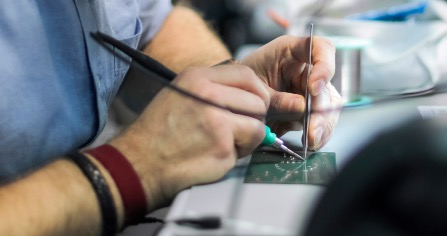
IPC Competition at Productronica Munich 2023
#2: JBC just unveiled a battery-powered soldering station—what inspired you to develop this cordless technology? What was the market demanding?
The inspiration behind B.IRON, our battery-powered, cordless soldering iron, came from a combination of market demand and our commitment to innovation. For years our customers, especially engineers and technicians working in field applications, have been asking for a more flexible, portable soldering solution — one that would give them the ability to move around without being tethered to a cord. The traditional, corded soldering irons are great for stability and power, but they can be limiting when you need to work in tight spaces, or when you're performing rework or repairs in environments where mobility is crucial.
Its cordless design makes it particularly efficient for soldering under a microscope. Without cables to get in the way, users can enjoy improved visibility and precision when working on intricate, small-scale tasks.
This design enhancement makes it easier to maneuver and focus on the fine details of soldering, which is a key advantage in applications that require high precision.
We've listened to that feedback and recognized that there was a need for a solution that combined the high performance JBC is known for with the convenience of a cordless design. B.IRON answers that need by offering a battery-powered system that allows professionals to work without being constrained by cords, making it especially valuable in dynamic, mobile environments, such as in prototyping labs, or for field service technicians.
Our goal with B.IRON was not just to remove the cord but to enhance the overall soldering experience. We wanted to maintain the high level of precision, control and efficiency that our customers expect from a JBC tool, while giving them the added benefit of mobility.
So, the driving force behind this product was a direct response to the evolving needs of our customers and our desire to keep pushing the boundaries of what's possible in hand soldering technology. B.IRON represents a new era in soldering tools, blending cutting-edge battery technology with JBC's longstanding commitment to performance and innovation.
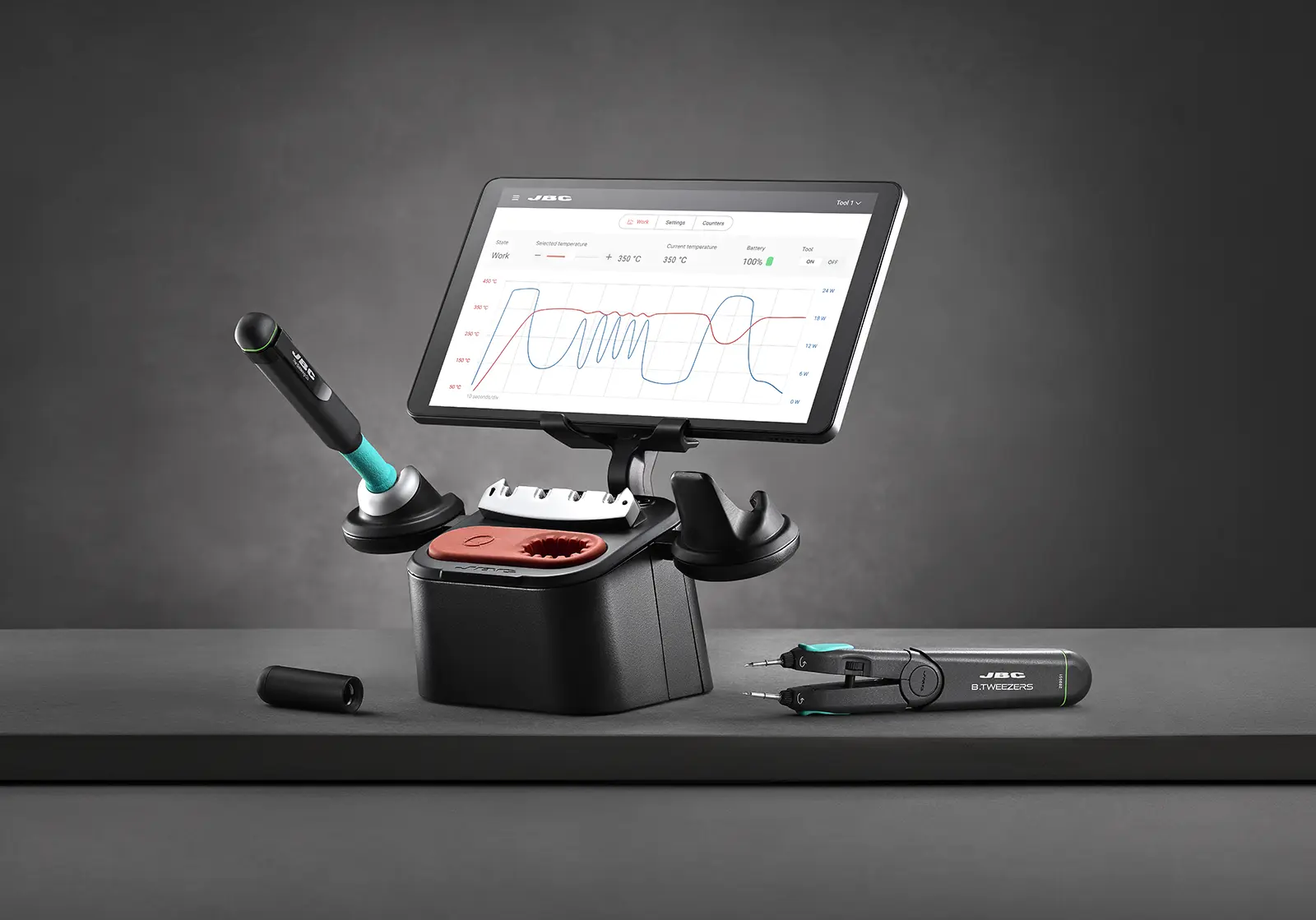
B.IRON Battery-Powered System
#3: Can you tell us, what are some real-world scenarios where users prefer starting with a battery-powered station?
The introduction of B.IRON, our battery-powered system, opens a wide range of new uses where mobility, flexibility and precision are critical. Some of the scenarios where a cordless soldering iron truly makes a difference, would be in:
Tight Spaces — Many of our customers work in field service and repair environments, where the ability to move freely around equipment and systems is essential. For example, technicians working on automated machines, industrial control systems, or even aircraft electronics often need to perform soldering tasks in tight or hard-to-reach areas. Traditional corded soldering irons can be cumbersome in such situations. B.IRON, being cordless, gives technicians the possibility to move around, reach into confined spaces, and work efficiently without the limitations of tangled cords or power outlets. Whether it's fixing a broken component in a control panel or repairing a PCB in the field, B.IRON makes the job much easier.
Prototyping and R&D — Prototyping is another area where B.IRON shines. Engineers and researchers who are developing new circuits or experimenting with different designs often need to solder components in a flexible and dynamic environment. Since prototypes often involve frequent changes and adjustments, it’s critical to be able to adjust and move around the workspace quickly and easily. With B.IRON, you can work without any attachments — no need to worry about finding a power source or dealing with the tangle of cords that might get in the way during rapid prototyping. This makes B.IRON especially useful for research labs, startup teams, and electronics engineers working on new innovations.
Soldering in remote or harsh environments — B.IRON is also beneficial for industries where soldering might be required in remote or extreme environments, such as field research or military operations. In some of these settings, access to power outlets or generators can be very limited or impractical. With B.IRON, technicians can continue their soldering tasks in areas where other tools might reach their limits. It’s well thought-through design also ensures it can withstand tough conditions, making it suitable for use in harsh outdoor environments or places where typical workbenches aren’t available.
Educational and training purposes — Another interesting use is in education and training environments. In schools, workshops, and training facilities where students and apprentices are learning hand soldering, the cord-free nature of B.IRON allows them to move around and collaborate more easily without getting tangled up in wires.
In summary, B.IRON's cordless design opens a world of possibilities for professionals who need mobility, precision and flexibility in their work. Whether it’s repairing equipment in the field, working in confined spaces, moving between different workstations, or performing high-precision soldering in dynamic environments, B.IRON is designed to enhance productivity and convenience across a wide range of industries and use cases.
#4: What specific tasks or scenarios make a battery-powered or corded station the better choice and how does having both improve workflow flexibility?
Absolutely! Our B.IRON and traditional corded JBC soldering irons are designed to complement each other perfectly on the bench, offering reliability and versatility for different types of soldering tasks.
First, versatility for different applications — While other traditional JBC stations are fantastic for continuous, high-power tasks that require consistent heat over extended periods — like large-scale PCB assembly or heavy-duty rework — B.IRON excels when mobility or precision in tight spaces is needed. On a busy workbench, having both types of irons allow users to choose the best tool for the specific task at hand.
And second, optimized workflow and flexibility in complex jobs - In jobs that require both detailed, high-precision work and more extensive soldering, the cordless and corded irons complement each other by handling different parts of the job. For example, when repairing circuit boards that have both large components (which may require more power) and small, sensitive components (which need precise, controlled heat), the technician can start with the corded iron for the heavy-duty components and switch to B.IRON for the finer, more detailed soldering.
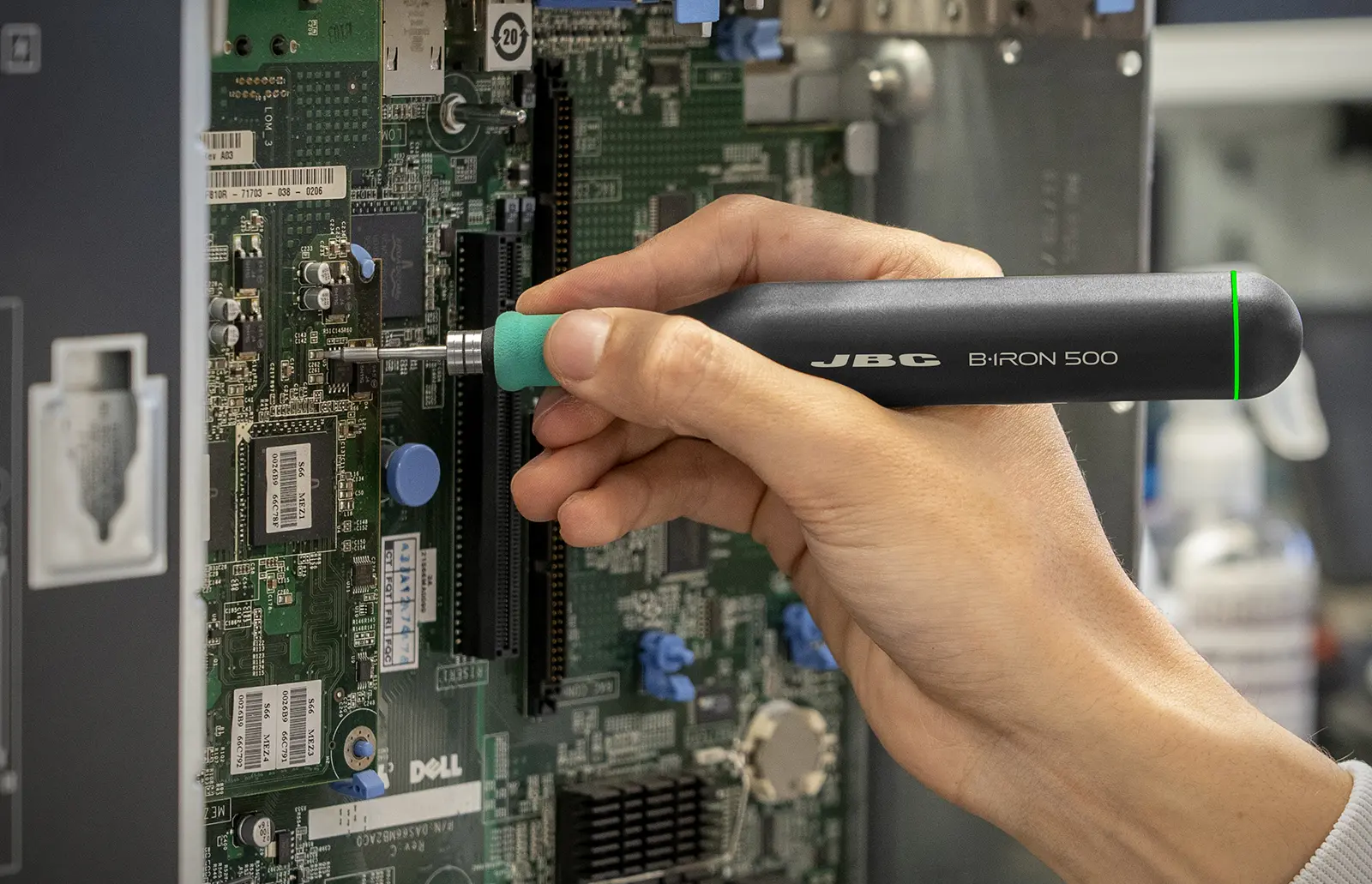
B.IRON being used to repair a mounted PCB
#5: B.IRON was clearly designed with specific use cases in mind, but we’re curious—have there been any particularly surprising or innovative applications from customers that made you rethink its potential? Maybe unexpected industries adopting it, creative workarounds for niche problems?
That’s one of the most exciting aspects of a product like B.IRON — seeing how creative and resourceful our customers can be with it!
We’ve heard from several startups and racing teams who are using B.IRON in mobile prototyping scenarios. These teams often work in fast-paced, collaborative environments and need to iterate quickly on prototypes. The freedom to move around the workspace, quickly solder new components onto a circuit and adjust designs on the fly has been a game-changer for them.
B.IRON’s cordless design has given them a significant advantage, providing them with the versatility to handle unexpected issues during a competition.
In the fast-paced world of racing, where technical problems can arise at any moment, the ability to quickly solder or rework circuits in real-time is crucial. B.IRON allows the teams to move around the pit area or workshop without being constrained by cords or needing to set up additional power sources. Whether it’s a quick electrical fix in the car’s electronics or modifying a sensor on the spot, B.IRON gives these teams the opportunity to react immediately to problems during critical moments, where the difference between finishing the race or falling behind can be a matter of seconds.
#6: What specific advantages does a cordless soldering iron offer over traditional models that lead to a better return on investment?
By eliminating the need to adjust or reposition cords, technicians can work faster and more efficiently. This is especially valuable in dynamic environments where workers need to move around frequently, such as in field repairs or on-site installations. The ability to work in any space without the constraints of cords saves valuable time, which translates directly into increased productivity. As technicians complete more tasks in less time, businesses can see a significant boost in ROI over time.
The result is increased productivity and reduced waste — leading to significant savings for businesses. Whether for high-volume production or low-volume prototyping, B.IRON proves to be a smart investment that helps companies maximize resources and deliver more value with less overhead.