News Center Articles Is Hand Soldering Still Relevant in a World of Automation?
In an era dominated by high-speed surface-mount technology (SMT) and fully automated assembly lines, it is easy to assume that hand soldering is obsolete. However, the reality tells a different story. Hand soldering tools remain essential fixtures in R&D labs and specialized manufacturing facilities worldwide. Far from fading away, manual soldering is experiencing a renaissance. As the electronics industry moves faster than ever, the need for efficiency and uncompromising sustainability has made hand soldering more critical than ever.
Here are the key areas where hand soldering continues to play a vital role in 2026:
Efficiency is a prerequisite for survival in today's competitive landscape. Before any product reaches an automated production line, it begins as a prototype, where engineers rely on hand soldering to quickly test and refine new circuit designs. Unlike expensive automated setups that require extensive programming, manual soldering enables rapid adjustments and one-off customizations. To facilitate this crucial work, professional systems like the JBC B.IRON —a battery-powered, cordless iron—offer technicians the necessary freedom and precision. This cordless design facilitates work in tight spaces or under microscopes with improved visibility. Ultimately, in a fast-paced industry, the agility to swap a resistor or reroute a trace by hand remains an unmatched competitive advantage.
While automation is increasingly sophisticated, it is not yet perfect, often producing flaws or encountering complex scenarios, such as solder bridges, tombstoning, or misaligned components, that it isn't programmed to handle. This is where skilled operators provide the "surgical precision" needed to perform critical rework in areas that reflow ovens and wave soldering machines cannot reach. To ensure these reworks don't compromise the board’s integrity through thermal shock, advanced equipment like JBC Preheaters becomes essential; they gradually warm the PCB to reduce the thermal shocks, preventing board warping and allowing for component removal at lower, safer temperatures. For more intensive repairs, JBC´s RMSE Rework System offers a complete "operating room" for electronics by integrating soldering, desoldering and hot air tools into a single workflow, enabling technicians to tackle everything from clearing through-holes to the high-precision reflowing of delicate SMD parts. By investing in these high-precision tools, manufacturers can effectively manage the nuanced thermal requirements of the rework process, ensuring that every corrected board meets the same IPC Class 3 standards as those produced on a flawless assembly line.
For low-volume electronics production, manufacturing quantities often do not justify the massive investment required for automated machinery. In these scenarios, hand soldering provides superior quality control and precision. It allows manufacturers to maintain high standards for specialized products where every connection matters and human oversight adds a layer of reliability that machines cannot yet replicate for unique builds.
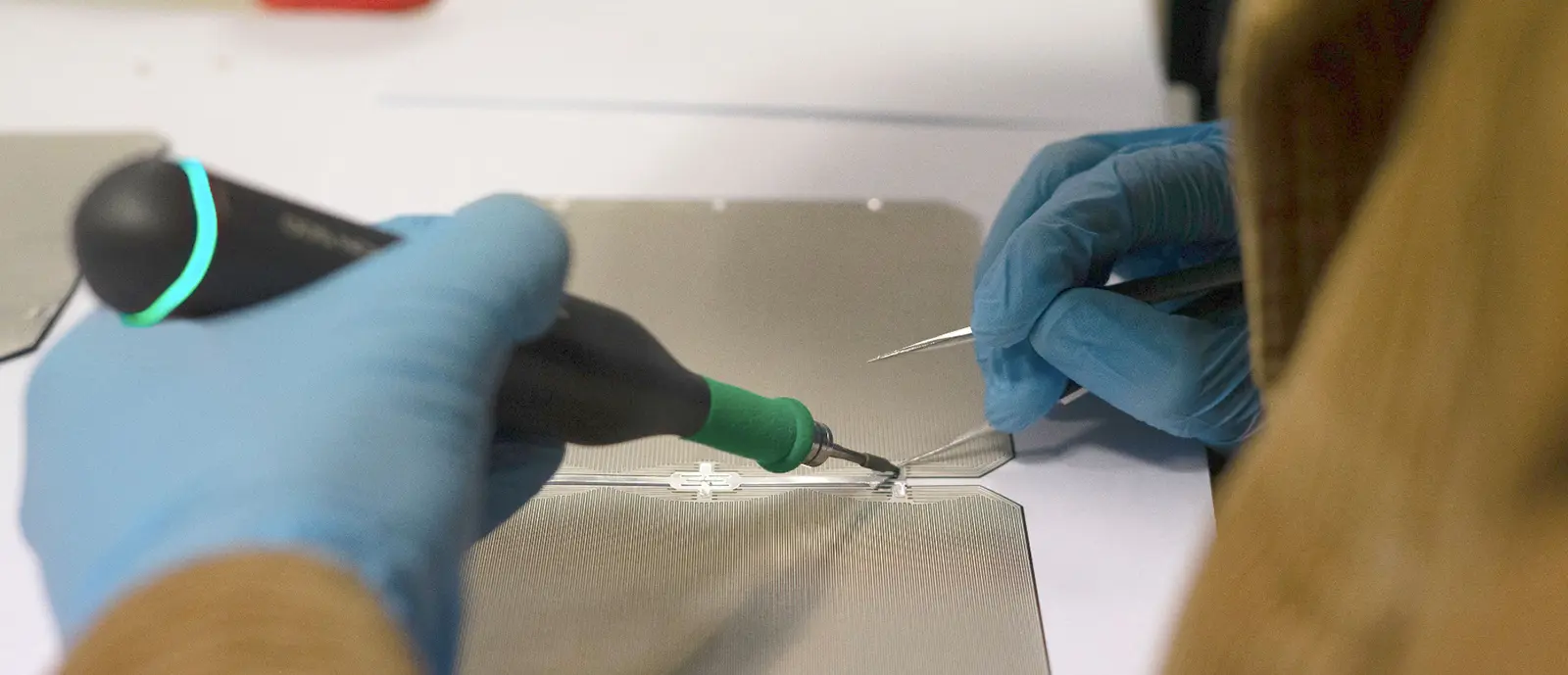
B.IRON 500 being used for hand soldering solar panels
As the global economy pivots toward a circular model, disposable electronics are falling out of favor. Hand soldering serves as the primary tool for rework and repair, allowing technicians to replace faulty components without discarding entire circuit boards. This approach significantly reduces electronic waste while proving cost-effective for high-value equipment. At the heart of this sustainable mindset are precision tools like those from JBC Soldering Tools, which provide the accuracy and thermal efficiency required to meet modern environmental demands.
Not all repairs happen in sterile labs. In the automotive, aerospace, and energy sectors, maintenance often occurs on-site or directly in the field. Portable hand soldering tools are essential for keeping critical systems operational in environments where robotic assembly lines cannot go. A standout solution for these scenarios is JBC B.IRON Battery-Powered System, which provides the power of a professional station without cable restrictions, ensuring reliable performance exactly when and where it’s needed most.

FS Bizkaia perfoming PCB rework with JBC´s DDE 2-Tool Station
Hand soldering remains a fundamental pillar of technical education. Mastering a soldering iron provides electrical engineers and technicians with a deeper, tactile understanding of electronics assembly and troubleshooting. In 2026, this "hardware literacy" is a highly valued industry asset. JBC remains committed to sharing this passion for hand soldering and rework by actively supporting educational projects and the IPC Hand Soldering Competitions. Through these efforts, the next generation of engineers is equipped with the best technology and techniques to bridge the gap between theory and practice.
As technology grows more complex, the human touch of a soldering iron proves that some traditions don't just survive—they evolve. Whether viewed through the lens of environmental sustainability or the pursuit of cutting-edge innovation, hand soldering remains an indispensable bridge between digital concepts and physical reality.