News Center Articles How JBC Automatic-Feed Soldering controls solder volume in high-reliability manufacturing and why it matters
In electronics manufacturing, two of the most critical factors affecting joint reliability are temperature and solder volume. The natural focus tends to fall on temperature, but that alone is only half the equation. If the amount applied varies from joint to joint, the assembly will behave inconsistently, regardless of how well the thermal process is controlled. Volume is not a supporting variable, it is a decisive one. In high-reliability manufacturing, across aerospace, and medical, controlling it precisely is not optional, and it is exactly what automatic feed soldering is designed to achieve.
In these industries, a solder joint does more than just carry electricity, it acts as a mechanical bridge, which must survive constant vibration, extreme temperature changes, and years of physical stress. If the amount of solder is inconsistent, the joint develops internal weak spots. Over time, these weak points will crack or snap under the pressure of the environment.
ALE Station is JBC's most advanced Automatic-Feed Soldering solution, built around ALE Control Unit paired with compatible irons, including ALE250 and the new ALEP250, its most ergonomic and programmable tool for industrial production. Together they ensure the correct amount of solder is applied under the right thermal conditions on every joint, by synchronizing a precision wire feeding mechanism with JBC Exclusive Heating System.
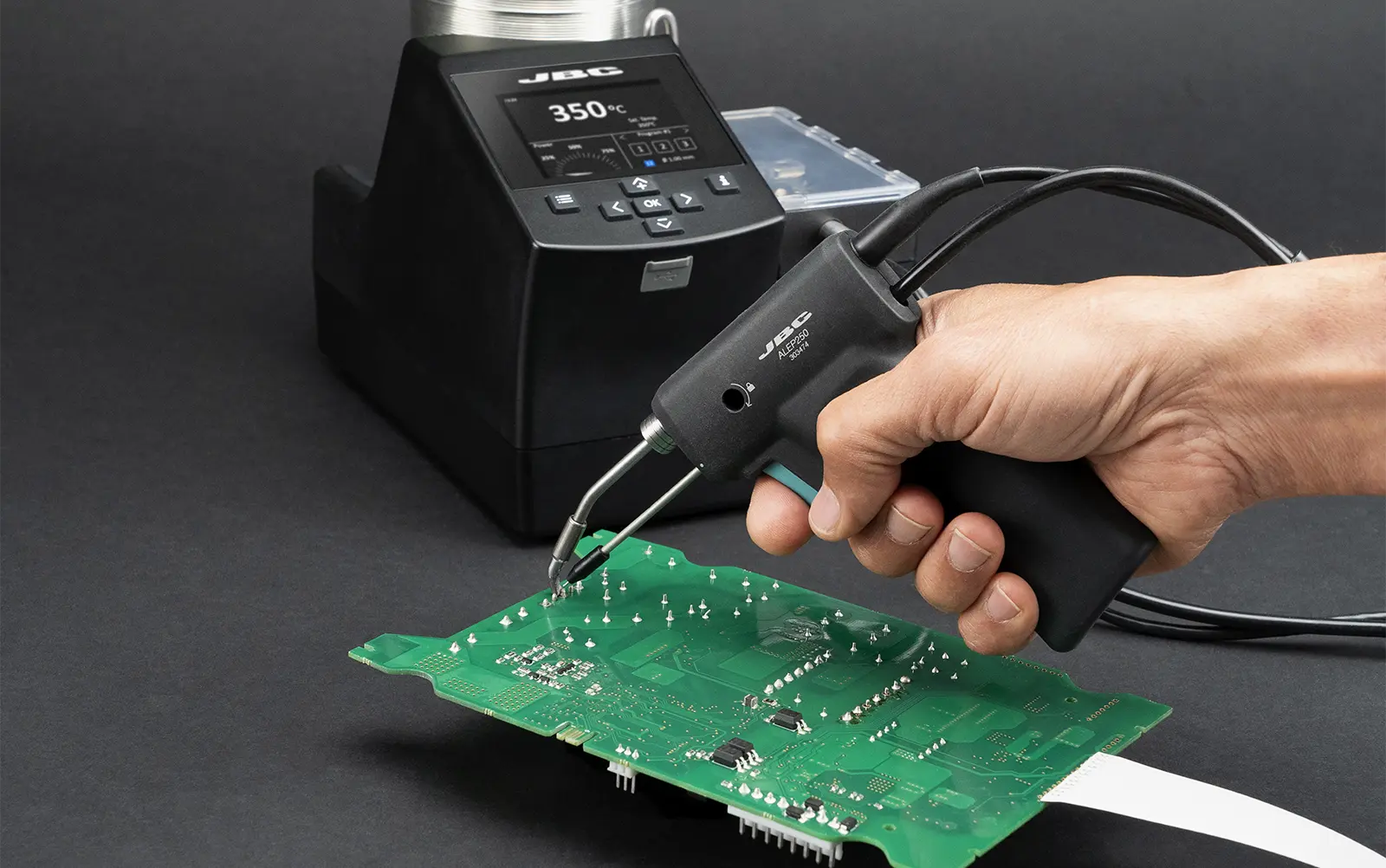
ALEP250 Automatic Feed
In manual soldering, the volume of solder delivered depends entirely on operator technique: the angle of the wire, the feed duration, and the reaction speed at the moment of application. Even among highly experienced users, these factors introduce small but inevitable variations, which may accumulate over time into inconsistent joint geometry, irregular fillet sizes, and unpredictable reliability across the assembly. This is where an automatic solder feeder becomes essential, replacing operator variability with a controlled, repeatable process.
This matters because solder joints carry responsibilities beyond electrical conduction. In high-reliability assemblies, they are structural components that hold parts in place, absorb vibration, and transfer mechanical loads. When volume is inconsistent, the following functions are at risk:
Structural integrity: Circuit boards expand and contract when temperature changes, and solder joints do the same, but not at exactly the same rate. If solder volume is inconsistent, the resulting stresses can concentrate in weaker areas and eventually lead to cracks. When it is consistent, stress is distributed more evenly across the joint, improving long-term durability.
Load bearing: For components such as connectors, inductors, and other heavy power parts, the solder joint is the main mechanical support that keeps them attached to the PCB. To ensure a strong connection, the solder must completely fill the hole and bond properly with the pad. JBC Exclusive Heating System brings the joint to the correct temperature quickly and evenly, allowing the solder to flow fully into the barrel and create a strong, durable hold.
Bond quality: Solder wire contains flux, which improves solder flow and wetting, ensuring a cleaner and more reliable joint. However, flux only works for a short time at high temperature. If the solder is fed too slowly, the flux can burn off before the joint is fully formed, leading to a weak and oxidized connection. ALE Control Unit delivers the right amount of solder at the right moment, allowing the flux to work correctly and ensuring a strong, reliable bond.
ALE combines a precise wire feeding system with a thermal response measured in milliseconds. This ensures that solder is always fed under stable thermal conditions. As a result, each joint is formed with consistent solder volume, while final joint quality remains dependent on operator technique.
Three operating modes are available to cover different production needs:
Discontinuous Mode: When the operator presses the trigger, a pre-set length of solder wire is automatically fed. This is ideal for repetitive tasks where the same type of solder joint must be made many times. It is especially useful for IPC Class 3 through-hole assemblies, where the solder must fill 75% to 100% of the hole height to comply with IPC standards.
Continuous Mode: Solder feeds at a constant speed for as long as the trigger is held. This mode is the right choice for large, heavy components like busbars, battery terminals, and power electronics, where the joint needs sustained heat and a generous volume of solder to ensure proper filling and a strong connection.
Program Mode: The operator can store up to five custom programs, each with three adjustable steps that control the solder wire length, speed, and timing. This allows the solder to be fed in a controlled sequence, such as starting slowly to activate the flux and then feeding faster to finish the joint. Once the program is set, the same process can be repeated every time, ensuring consistent results even with different operators.
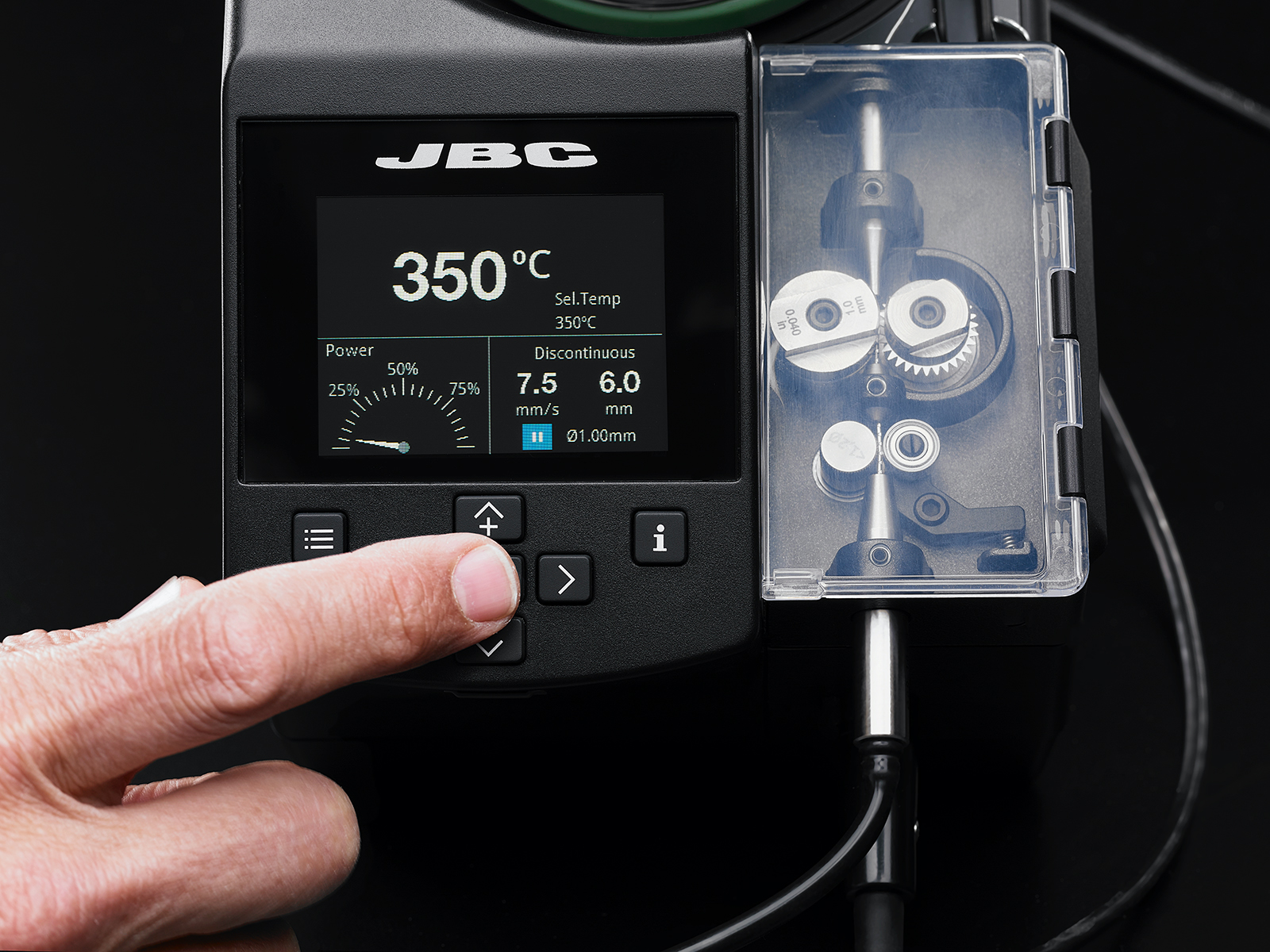
User-friendly menu
ALE Control Unit features an integrated solder wire perforation system compatible with wire diameters from Ø 0.8 to 1.6 mm. As the wire is fed, a small perforation is made down to the flux core, allowing gases to escape gradually before the solder melts. This controlled release prevents pressure from building up and avoids the sudden gas bursts that can occur during soldering.
ALE System is designed for continuous industrial use. It supports solder reels of up to 2 kg, allowing production to run longer with fewer interruptions. ALEP250 further extends this efficiency with a handle optimized for single-handed operation, reducing fatigue during repetitive tasks on high-volume production. Sleep and Hibernation Modes automatically lower the tip temperature when the tool is not being used. This protects the cartridge and extends its lifespan, especially when working with lead-free alloys.
ALE System also allows connection to JBC FAE Fume Extraction Systems, which activates automatically when soldering starts and removes fumes before they reach the operator. This keeps the work area cleaner and safer.
ALE Automatic-Feed Soldering Station
Temperature and volume are not two separate concerns, but two halves of the same process, and both need to be controlled with equal precision for the result to be truly reliable. JBC brings both together in a single, integrated system that synchronizes Exclusive Heating System with programmable, repeatable material delivery and full process traceability.
In aerospace, and medical manufacturing, a failing solder joint can translate into serious consequences. The impact is not just scrap or rework, but grounded aircraft, recalled medical devices, or failed missions. This is the real cost of an uncontrolled process. That is why precise control of both solder volume and temperature is essential in these industries.
JBC Automatic-Feed Soldering solutions are designed to deliver that level of precision and consistency.